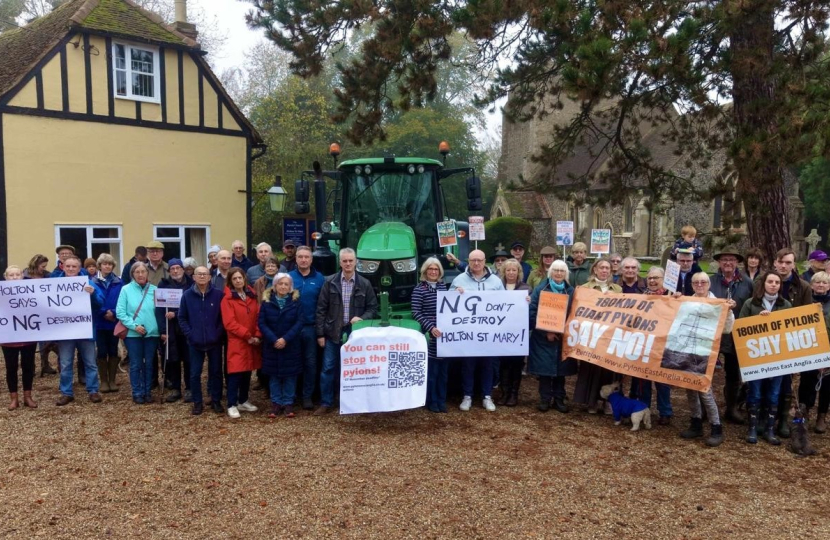
EXCLUSIVE: One aggrieved farmer said the pylons will have a "massive impact" on his farm and blasted the scheme as "absolute nonsense".
Angry farmers assembled their tractors in the middle of a Suffolk village in protest over controversial National Grid plans for a new 114-mile pylon route. A dozen tractors were part of the rally in Cotton, near Stowmarket, as part of a day of action across East Anglia against the proposals to transport green electricity through pylons from Norwich to Tilbury in Essex.
Andrew Bullicks, who runs a family farm in the Cotton area, attended the protest and said the construction plans are “absolutely crazy”. He said one-third of his land will be unusable while the pylons are built. Mr Bullicks, 62, told the Express: “The whole project is an absolute nonsense.
“It’s supposed to be a net-zero project, the whole net-zero thing is a bloody nonsense when it comes to schemes like this.
“It’s going to have a massive impact on our business.”
Labour has set a target of having a clean power system by 2030.
National Grid plans to build more than 500 pylons as part of the Norwich to Tilbury route, carrying energy from new wind farms off the east coast.
The pylons are set to be 164ft tall (50 metres), almost the height of Nelson’s Column which is slightly over 169ft (52 metres).
Campaigners have voiced concerns over the impact the structures will have on the region’s landscape.
Nearly 40,000 people have signed a petition urging National Grid bosses to build an offshore grid instead, while there have also been calls for the power lines to be built underground.
Demonstrations against the plans took place in at least eight East Anglia villages on Saturday.
Tory MPs James Cartlidge and Bernard Jenkin both attended protests in their constituencies.
Mr Cartlidge said: "There is a narrative that somehow to oppose pylons for Norwich-Tilbury is ‘NIMBYism’ — when what my constituents wanted from the outset was simply to be treated fairly, with transparency from National Grid on all the options.
"Instead, NG dismissed these calls, and assumed pylons were better without properly assessing the alternatives.
"Eventually, we got an expert study from grid operator ESO that showed underground HVDC [High-Voltage Direct Current], the default legal option in Germany, was the cheapest option — even compared to pylons.
"This would protect the countryside, is widely supported by local people but would also deliver the infrastructure we need, and is the option I am committed to campaigning for."
The demonstrations were organised by the Essex, Suffolk and Norfolk Pylons campaign group.
Its founder Rosie Pearson said the pylons will be an “unimaginable scar” through East Anglia’s countryside.
She told the Express: “It's going to rip out hedgerows, habitats, woodlands and destroy farms.
“We know businesses that are probably going to have to close because of the pylons.
“We know that people are really worried about the impact on their house prices and seeing that already happening. It's just horrific.”
Ms Pearson said the protests aimed to raise awareness that residents have a “last chance” to voice concerns over the plans.
Ahead of a November 27 deadline, people are being urged to register and share their views with the Government’s planning inspectorate.
National Grid has insisted pylons are the cheapest and most viable option.
The plans were initially put forward in 2022 to help the previous Conservative government achieve its ambition of decarbonising the power system by 2035.
A National Grid spokesperson said: “With electricity demand expected to double in the next few years, the Norwich to Tilbury project will strengthen electricity capacity across East Anglia, a powerhouse of offshore wind and renewable generation, helping to deliver cleaner, more affordable, secure and home-grown energy to where it is needed most, in Norfolk, Suffolk, Essex, and beyond.
"We’ve been listening to local communities and representatives over the past three years — through hundreds of consultation events, online forums, and direct conversations."
A DESNZ spokesperson told the Express: “We need new infrastructure to protect family and national finances with energy security, through clean homegrown power we control, and connecting new transmission projects will cut down on constraint payments.
“All projects are subject to a rigorous planning process, in which the views and interests of the local community are considered.”
Published by the Daily Express.