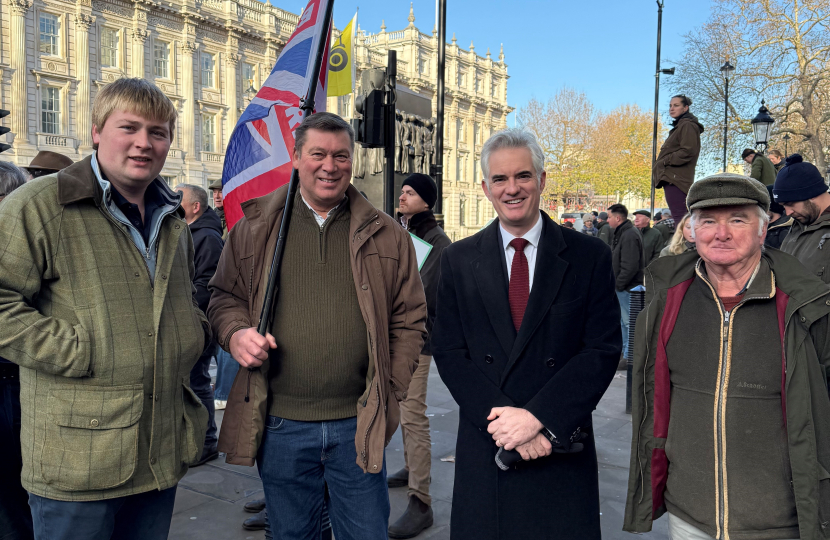
Holbrook farmers Harry and Chris Suckling, South Suffolk MP James Cartlidge and Shotley farmer Richard Wrinch at the protest in London.
Suffolk farmers campaigning against farm inheritance tax say they will fight on after a week of protest around the Budget.
They were unimpressed with a "token" concession over the controversial tax by chancellor Rachel Reeves in her Budget Day speech on Wednesday increasing the amount transferable between spouses.
Around 100 tractors took to the county's roads on Monday to voice their opposition to the new tax - which is due to come into force in April next year.
Tractors covered in placards weaved their way past Ipswich and Felixstowe docks.
On Wednesday, some joined a national demonstration in London - but felt their right to free speech was curtailed when a tractor ban order from the Metropolitan police went out unexpectedly on the eve of the protest.
They also felt that the protest was not well-managed and this led to more problems.
Police banned tractors in Whitehall during chancellor Rachel Reeves speech. Some arrests were made.
Despite the ban, a convoy of about 11 Suffolk and Essex tractors met at Colchester and headed down to the wider London area.
They included Tattingstone farmer Russel Abbott of East Anglia Farmers Unite - a protest organisation was set up in the wake of last year's Budget when the farm tax announcement was made and has organised three tractor protests in Suffolk since.
"It was good to be there and be a part of it," said Russel, who headed out at 4.45am and didn't get home until 8.30pm.
"The atmosphere was fantastic. Everyone was there for the same cause - the same reason. It almost came to a head that day that everyone could see that as an end of a long year of protest.
"Where it will go from here I don't know - there are a lot of unhappy people out there - it's their lives and their livelihoods."
More: Businesses 'left with stark choices' as tax burden hits record high
He saw "men in tears" at the protest as they explained how it would affect them, he added.
A number of Suffolk farmers felt the Westminster tractor ban order was politically motivated. Some opted to go by down by train to avoid confrontation with police.
They felt that unlike previous farm protests the effect this time was dissipated as farmers headed to different sites around Whitehall, Trafalgar Square, The Strand and Embankment - but they said they were glad to have taken part.
Potato farmer Chris Suckling of Holbrook, near Ipswich, went by train with son, Harry. "They tried to stifle us without a doubt - and quite successfully really," he said.
The spousal concession was "token" he added. Farmers can gift their farms or assets - but must survive seven years for it to take effect fully.
"People were hoping that farmers over the age of 80 would be exempt to give their families a chance to do some succession planning but that chance has been taken away.
"That would have taken the pressure off given the seven years needed to do the planning."
But the campaign to overturn the tax would go on - while farmers pin their hopes on a change of leadership in government which might lead to change, he said.
"We have got to push on - we have got to keep it out there," he said.
Farmer John Collen of Gisleham, near Lowestoft, abandoned his plan to take three tractors down and went by train instead after the "11th hour" ban.
"The Met should have taken this decision much earlier," he said. "What reinforced my resolve to go was they were arresting farmers that legitimately might not have got the message."
He added: "Obviously it was diluted from what it should or would have been in that I went alone rather than as three."
It meant that the protest was much scaled down. "100% the chancellor did not want any disruption to her big day.
"Ironically the Office for Budgetary Responsibility (OBR) did that for us (by mistakenly publishing their report before the Budget speech).
"That order I'm absolutely certain came from above that she didn't want disruption on her big day.
"We have a government that doesn't want to listen to the rural vote," he said.
National Farmers' Union (NFU) president Tom Bradshaw came up with a plan where tax is paid upon farm sale which would have netted the government more, he added.
"Any tax has to be sustainable - agricultural inheritance tax is not sustainable. To pay the bill I'll have to sell some of my farm."
And the concession made in the Budget on spousal transfer - while welcome - doesn't go far enough, he said.
The chancellor says a £1m threshold for agricultural inheritance tax will now be transferable between spouses.
This means that if a married farmer dies, they can leave the farm to their spouse and the spouse will be able to use the deceased's £1m in addition to their own £1m allowance to hand to their children on their death.
Shotley farmer Richard Wrinch joined the protest after heading down by train.
He was upset at the decision to ban tractors. "They tried to change the whole idea of the protest by banning tractors," he said. "The whole effect of free speech and demonstrating was very significantly restricted."
He felt the chancellor's concession would do "very little" but he and his wife would be sitting down with their accountant to see how they could limit the damage of the new tax for the next generation.
Farmer Will Hitchcock of Ringshall, near Stowmarket, said he took his tractor down to London on Budget Day but avoided the tractor ban zone around Whitehall.
It was "humbling" to see such enthusiastic public support for farmers, he said. "People on the street went to shake our hands. Pedestrians were giving us thumbs up and clapping us."
In his family, as his grandfather is widowed, the spousal transfer won't apply.
"It makes it even more hurtful that people who are widowed aren't eligible," he said, pointing out that there were thought to be around 46% of farmers who are single anyway.
NFU member Andrew Blenkiron, managing director of Elveden Farms near Thetford, was disappointed with the lack of movement in the Budget on the new farm tax.
“It is hugely disappointing that the government did not take the opportunity in this Budget to make significant changes to this cruel and damaging family farm tax policy.
“The small change announced does not protect the majority of small and medium-sized family farms across East Anglia, many of which have fed the nation for generations and now face an uncertain future.
“The inheritance tax proposals continue to stifle investment, have a devastating impact on the entire rural economy and do little to tackle the issue of people just buying land to avoid paying tax.
“The government continues to leave elderly farmers in a hugely irresponsible position and is putting our national food security under threat."
He urged MPs, councillors and other that had supported them in challenging the policy to keep up the pressured.
“I urge you to keep supporting us as the NFU continues to fight for its members and, I’m sure, will announce its next steps in due course.”
Country Land and Business Association (CLA) East director Cath Crowther urged farmers to register for their free Succession Roadshows across the East Region on December 9 and 10 – which are open to members and non-members.
“We are currently working through the final detail in the chancellor’s Budget to assess what is in store for family farms and rural businesses but with rural not mentioned at all within the chancellor’s Budget it is clear the huge potential of the rural economy is still not recognised," she said.
“In the region, and nationally, the CLA has been battling with a Treasury unwilling to listen to evidence which demonstrates the catastrophic nature of their Inheritance Tax changes effective from April next year.
"The pursuit of Labour backbenchers to rebel and support the cause has gained some traction, but further work continues.”
Mr Bradshaw said other measures in the Budget would also hit farmers including a rise in the National Living Wage but said farming may benefit from the announcements on apprenticeships.
He added that "the fight continues" over farm inheritance tax.
Published in the East Anglian Daily Times.